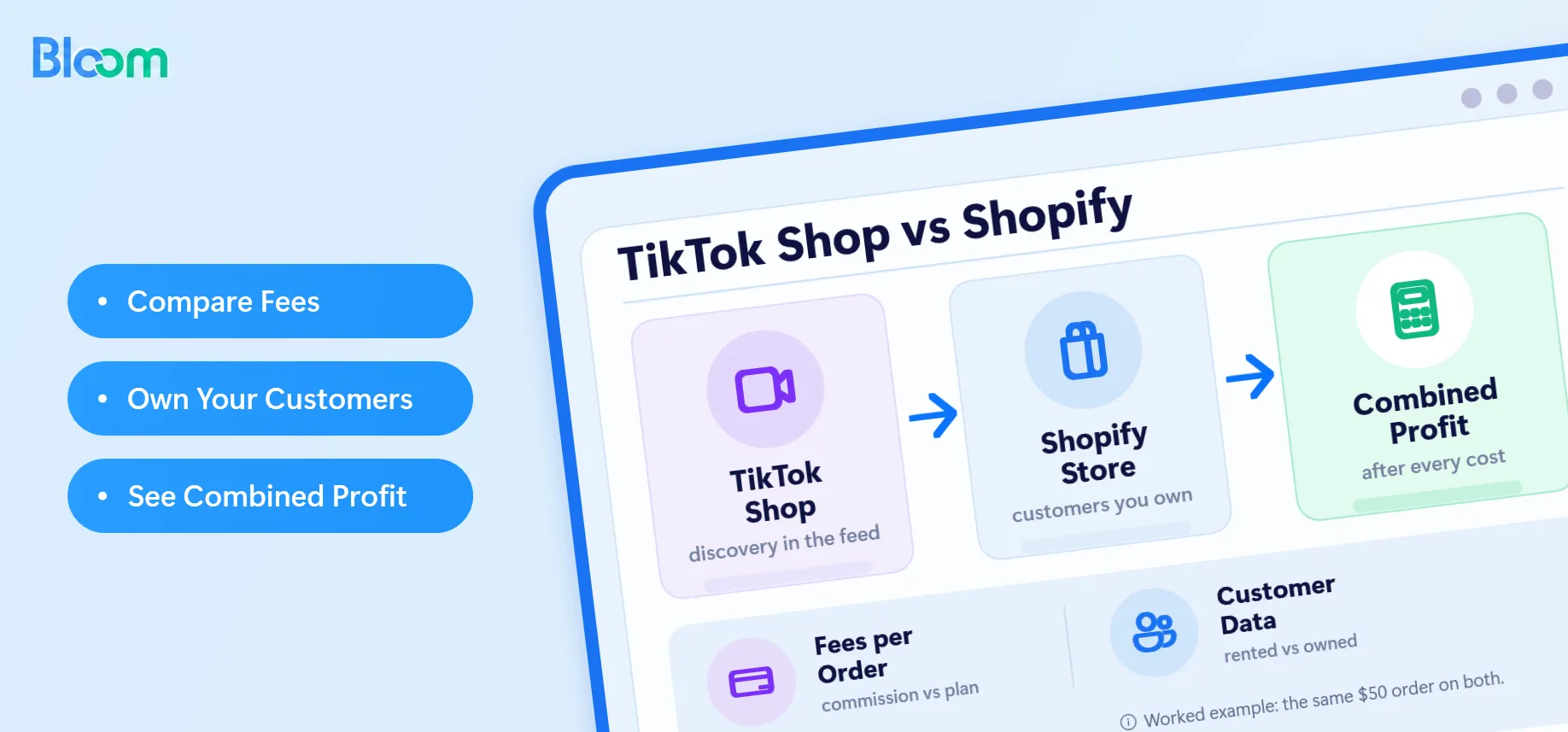


TikTok Shop and Shopify both let you sell online, but they are built for opposite jobs. Shopify is a store you own and run on your own domain, where the customer comes to you. TikTok Shop is a checkout layered inside a social feed, where the platform brings the customer to the product. That one difference shapes everything else: setup, discovery, shipping, fees, repeat purchases, and how clearly you can see whether you are actually making money.
This guide walks both platforms side by side, in the order a merchant experiences them. No feature grid. Just how each one works in practice, with a worked cost example and an honest look at why neither dashboard tells you your true profit, especially once you are selling on both.
Key Takeaways
- Shopify is a store, TikTok Shop is a channel. Shopify gives you a branded site, your own domain, and full control. TikTok Shop gives you access to a 1 billion+ user feed, but the store lives inside the app.
- Discovery is reversed. Shopify traffic comes from your marketing (ads, SEO, email). TikTok Shop traffic comes from the algorithm, creators, and short-form video.
- Fees look small until you add them up. Shopify charges a flat monthly plan plus payment fees. TikTok Shop takes a commission per sale and pushes merchants into subsidized promotions.
- You own Shopify customers. You rent TikTok Shop customers. Shopify gives you email, phone, and order history. TikTok Shop restricts customer data and keeps repeat buying inside its own feed.
- The two work best layered, not chosen between. TikTok Shop sits at the top of the funnel for discovery. Shopify sits at the bottom for repeat purchase and lifetime value. First-order economics on TikTok, repeat-order economics on Shopify.
- Neither dashboard shows your true profit. Shopify Analytics stops at gross sales. TikTok Seller Center stops at GMV. Seeing combined profit across both channels needs a profit layer that reconciles every cost line in one view.
How do you set up a store on each platform?
Shopify setup is a sign-up flow. TikTok Shop setup is an application.
On Shopify, you create an account, pick a plan, choose a theme, add products, connect a payment processor, and point a domain. Most merchants can launch a basic store in a day. The platform is the same whether you sell one SKU or ten thousand. You control the site, the branding, the checkout, and the data.
On TikTok Shop, you apply to become a seller. You submit a business license, tax documents, and identity verification. Approval can take a few days. Once approved, you add products through Seller Center, link a shipping template, and either sync inventory from an existing store or manage it inside TikTok. The storefront itself is not a site you design. It is a product catalog that lives inside the TikTok app, surfaced through video tags, LIVE shopping, and the Shop tab.
What this means in practice
- Shopify is a store. You own the URL, the design, and the checkout experience.
- TikTok Shop is a sales channel. The store is a tab inside someone else's app, and TikTok decides the layout.
Most merchants who sell on TikTok Shop also sell on Shopify, Amazon, or both. TikTok Shop is rarely the only channel, because there is no home base to send customers to.
How do customers find your products on each platform?
Shopify customers find you because you went and got them. TikTok Shop customers find you because the algorithm chose to show your product to them.
On Shopify, traffic is something you build. It comes from Google search, paid ads, email, influencer campaigns, and direct visits. If you stop marketing, traffic drops. The upside is that every channel you build is yours, and you can measure it, scale it, and retarget visitors across the web.
On TikTok Shop, traffic is something the platform allocates. Short-form video is the main discovery surface. A single viral clip can drive thousands of orders in a day with no paid spend. A LIVE shopping session can convert at rates traditional ecommerce never sees. But you cannot force reach. The For You Page decides what to show, and most videos get a modest audience. Creator affiliates, where TikTok creators earn a commission to feature your product in their own videos, are often the fastest way to scale.
The practical trade-off:
- Shopify discovery is predictable and owned. You pay for traffic, but you control it.
- TikTok Shop discovery is explosive and rented. You get cheap or free reach when the algorithm picks you, nothing when it does not.
Ad formats also differ. Shopify stores typically run Meta, Google, and Pinterest ads driving to product pages. TikTok Shop ads (Video Shopping Ads, LIVE Shopping Ads, Product Shopping Ads) run inside the TikTok app and send users to in-app checkout, not to a website.
How does fulfillment, shipping, and returns work on each platform?
Shopify leaves fulfillment up to you. TikTok Shop enforces rules on how fast you ship.
Shopify fulfillment
You choose your own carriers, your own packaging, and your own shipping rates. You can self-fulfill from a garage, use a 3PL, drop-ship from a supplier, or plug into Shopify Fulfillment Network. Returns are handled through your own policy, your own portal, and your own customer service workflow. Nothing forces you to meet a specific speed or cost.
This flexibility is a feature for established brands and a tax for new ones. A beginner on Shopify has to figure out shipping zones, insurance, label printing, and returns from scratch.
TikTok Shop fulfillment
TikTok Shop sets service-level requirements. Merchants are expected to ship most orders within 1 to 3 business days, provide valid tracking, and keep late-shipment rates under a defined threshold. Fall below the bar, and your store loses visibility in the feed. In some regions, TikTok offers Fulfilled by TikTok, where TikTok handles warehousing and shipping. Everywhere else, you still run fulfillment yourself but under TikTok's rules.
Returns on TikTok Shop are platform-managed. Customers request a return through the app, TikTok adjudicates, and in many disputes the ruling favors the buyer. Refunds hit your payout before you see the returned product in some flows.
The practical difference
- Shopify gives you full control and full responsibility.
- TikTok Shop gives you a framework, strict service rules, and less room to negotiate with the customer directly.
What does it really cost to sell on each platform?
Shopify charges for the store. TikTok Shop charges for the sale.
Both model their fees around a different logic. Shopify's model is subscription plus payment processing. TikTok Shop's model is a commission on gross merchandise value (GMV) plus payment-related deductions. The headline percentages always look small. The math on a real order tells the truth.
Worked example: a $50 order
Assume a product that sells for $50, with $15 COGS, $8 shipping, and no returns on this order. Numbers are rounded for clarity and will vary by plan, region, and current rate card.
On Shopify (Basic plan, US rates, online credit card sale):
- Order revenue: $50.00
- Shopify monthly plan: not deducted per order (allocated separately)
- Payment processing (around 2.9% + $0.30): about $1.75
- Shipping cost: $8.00
- COGS: $15.00
- Gross contribution before ads and plan fees: about $25.25
Add roughly $5 to $10 in blended ad spend attributed to the order, and the net sits closer to $15 to $20. Then subtract your pro-rated monthly plan fee.
On TikTok Shop (US rates, standard category):
- Order revenue: $50.00
- TikTok Shop commission (commonly in the 6% to 8% range, category dependent): about $4.00
- Payment / transaction fees (varies by region and payout method): about $1.00
- Shipping cost: $8.00 (merchant-covered where applicable)
- COGS: $15.00
- Gross contribution before ads and promotions: about $22.00
Then factor in creator affiliate commissions (often 10% to 20% of GMV on affiliate-driven orders), platform-subsidized discounts you co-fund, and Video Shopping Ads spend. On an affiliate-driven order with a co-funded promo, the real net can drop below $10.
What the example shows
- Shopify's fixed costs look higher upfront but scale well. The percentage take drops as order volume grows.
- TikTok Shop's per-order take looks small but stacks quickly: commission, affiliate fee, co-funded promo, ads. Order-by-order margins are tighter than they appear.
Neither dashboard shows this math. Shopify Analytics reports gross sales. TikTok Seller Center reports GMV. The merchant has to reconcile both externally to see what they actually keep.
Who owns the customer relationship after the first sale?
Shopify customers belong to the merchant. TikTok Shop customers belong to the platform.
This is the single biggest long-term difference between the two, and it does not show up on day one.
Shopify: you own the list
Every Shopify order gives you an email, usually a phone number, a shipping address, and a full order history tied to a customer record. You can email that customer, add them to a loyalty program, retarget them on Meta or Google, and offer a repeat discount. Your repeat-purchase rate is a direct lever on lifetime value (LTV), and nothing stops you from pulling it.
Agencies and brands spend heavily on post-purchase: Klaviyo flows, SMS, subscribe-and-save, VIP tiers. The work compounds. A Shopify brand with a healthy repeat rate can out-earn a competitor with higher first-order revenue.
TikTok Shop: the platform owns the list
TikTok Shop restricts how much customer data the merchant sees. In many markets, you do not get the customer's real email, and contact rules limit outbound marketing. Repeat purchases happen inside TikTok, driven by the algorithm showing your next video to the same buyer, not by your own email campaign.
This is fine while the algorithm likes you. It is a problem the moment it stops. A TikTok Shop merchant who cannot export a customer list cannot migrate that audience to another channel.
The LTV gap
- Shopify LTV is a merchant lever. You can double down on retention and raise it.
- TikTok Shop LTV is a platform outcome. It rises and falls with the algorithm.
Most mature brands treat TikTok Shop as top-of-funnel acquisition, with Shopify as the home base where the customer relationship is stored and grown.
How do you measure which channel actually makes you more money?
Short answer: neither platform tells you.
Shopify Analytics and TikTok Seller Center both report revenue. Both report order volume. Both report conversion. Neither nets out the full stack of costs that turn revenue into real profit.
What each dashboard actually shows
- Shopify Analytics reports gross sales, sessions, conversion rate, average order value (AOV), and top products. It does not pull in ad spend attributed at the order level, true COGS across variants, returns net of restocking, duties, tariffs, chargebacks, or app subscription costs.
- TikTok Seller Center reports GMV, order count, video performance, and ad spend inside TikTok. It does not tie back to the COGS you track in Shopify, does not see Meta or Google ad spend that may have primed the buyer, and does not reconcile returns against original payouts in a clean way.
Each dashboard is accurate inside its own walls. Neither crosses the wall.
Why sell on both platforms?
For most Shopify merchants, the question is not Shopify or TikTok Shop. It is how to layer them.
The two platforms sit at opposite ends of the ecommerce funnel. TikTok Shop works at the top, where discovery happens in-feed through Shoppable Videos, LIVE Shopping, the Shop Tab, and creator affiliate content. Shopify works at the bottom, where repeat purchase, loyalty, email, and SMS compound on first-party customer data the merchant owns.
Run together, each platform offsets the other's weakness. TikTok Shop delivers top-of-funnel reach at a CPA that Meta and Google often cannot match. Shopify then captures that customer into an owned retention stack where repeat orders carry none of the TikTok commission, affiliate fee, or co-funded promotion drag. First-order economics on TikTok, repeat-order economics on Shopify.
What it actually takes to see profit across both
Running Shopify and TikTok Shop together means total profit is the sum of two channels with different fee stacks. To see it, and to compare what each one contributes, every order from both has to land in one view with the same cost lines applied:
- Revenue from Shopify and TikTok Shop, net of refunds
- COGS applied per order at the SKU level
- Shopify fees, TikTok Shop fees, and TikTok affiliate and promo costs
- Ad spend across Meta, Google, and TikTok, attributed per order
- Shipping, tariffs, duties, and chargebacks matched to orders
No native dashboard does this. Shopify Analytics stops at gross sales. TikTok Seller Center stops at GMV. Spreadsheets bridge them but go stale fast and break every time a fee, promo, or SKU changes.
Which platform is actually more profitable?
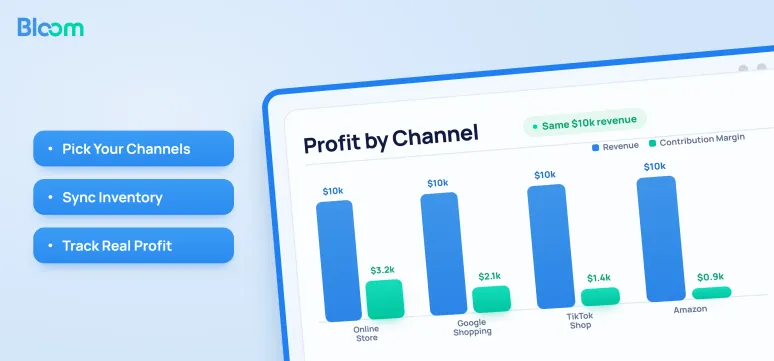
That depends on your product, your audience, and your cost stack. The honest answer is that you cannot answer it from Shopify Analytics or TikTok Seller Center alone. A merchant selling a high-margin product with strong repeat purchase usually earns more on Shopify over 12 months. A merchant selling a visually demonstrable product with viral potential often earns more on TikTok Shop in a given month. Most brands that scale end up on both, and the real question becomes: where should I spend the next ad dollar?
Answering that needs a profit view that pulls every cost off both platforms, not a spreadsheet. That is where Bloom fits in.
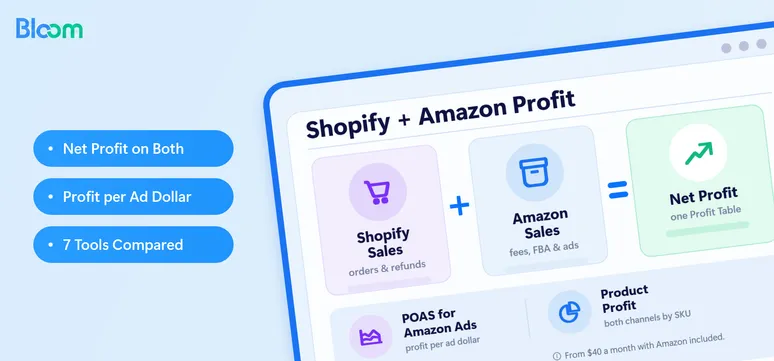
Bloom shows a full profit and loss view across Shopify and TikTok Shop in one place. Shopify is connected the moment Bloom is installed, so order revenue, plan and payment fees, and refunds flow in automatically. For TikTok Shop, Bloom pulls every line item that moves the bottom line: order revenue, commission, transaction fees, affiliate and creator commissions, shipping, promotions, and refunds, each matched to the order it belongs to. Ad spend from Meta, Google, and TikTok lands in the same view. You add COGS once, and Bloom turns it into a detailed P&L by order, by product, by day, and by channel. Real net profit per platform, and for the business as a whole. That is the number that tells you where to double down.
See your true profit across Shopify and TikTok Shop in one view
Frequently Asked Questions
Is TikTok Shop replacing Shopify?
No. TikTok Shop is a sales channel inside the TikTok app. Shopify is a store platform with its own domain. Most merchants who succeed on TikTok Shop also run a Shopify store as their brand home.
Can I connect my Shopify store to TikTok Shop?
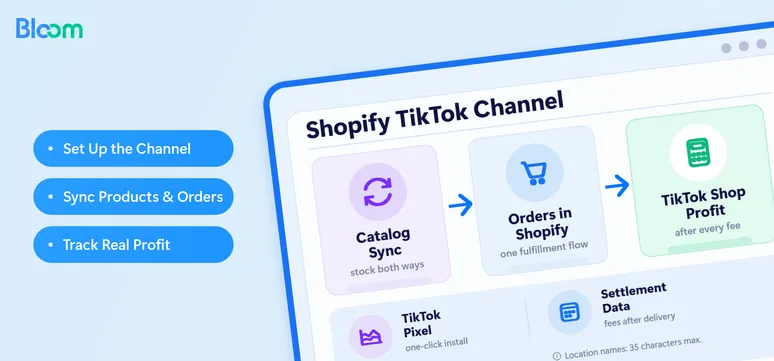
Yes. The official TikTok Shop app for Shopify syncs products, inventory, and orders between the two. You manage one catalog and fulfill from one place, while selling into both.
Which platform has lower fees?
Shopify fees are mostly fixed (monthly plan plus payment processing). TikTok Shop fees are mostly variable (commission on each sale plus affiliate and promo costs). On low volume, TikTok Shop can be cheaper per order. At scale, Shopify's fixed cost ratio usually wins, but only if you factor in the full ad stack driving traffic to your store.
Do I own my customer data on TikTok Shop?
Not in the same way as on Shopify. TikTok Shop restricts access to customer contact details, and outbound marketing to those customers is limited. On Shopify, you receive full customer data for every order and can market to that list within applicable privacy laws.
Can I see combined profit across Shopify and TikTok Shop in one place?
Not from the native dashboards. Shopify Analytics covers Shopify orders at gross sales level. TikTok Seller Center covers TikTok orders at GMV. Neither nets out COGS, cross-channel ad spend, affiliate fees, promos, shipping, and refunds together. Combined profit needs a dedicated profit analytics layer that connects to both platforms and reconciles every cost line per order.
How do I decide where to spend the next ad dollar?
Only after you can see net profit by channel in the same view. Looking at GMV on TikTok and gross sales on Shopify leads to the wrong call because the two numbers hide different costs. Once ad spend, fees, and refunds are matched to orders on both platforms, you can see which channel is actually paying back and move budget toward it.
Should I sell on both platforms?
Often yes, if your product fits short-form video and your margins can carry the TikTok Shop fee stack. TikTok Shop works well as top-of-funnel discovery and impulse buying. Shopify works as the home base where repeat purchase, loyalty, and lifetime value live. The combination only works if you can see, in one place, which channel is actually earning you money.